Mostrando entradas con la etiqueta INGLÉS. Mostrar todas las entradas

miércoles, 1 de septiembre de 2021

Pronouns - Something, Anything, Nothing, Somebody, Anybody, Nobody.

 1.We are sure  can be done under circumstances.

     2. I think he should buy  for the party.
     3. There is always  I don't understand.
     4. There isn't  serious with him.
     5.  ever interests this man.
     6. Is there  else you would like me to do ?                      

     7. He saw  over there.
     8. I don't want  at all.
     9. He has got very important news.  It's  you would  Like to hear.
 

                             Somebody, Anybody or Nobody.

 1. Answer the phone.  is ringing.
 2. Did you hear  's voice?
 3. Hello! Is  here?
 4. I think there isn't  in the room.
 5. She said she could recognize  because of their painted faces.
  6. If  comes, he will give you a call.
 7. Are you waiting for  ?
 8. We are sure there is  inside, just knock louder!
 9. Don't be afraid there is  there.
  10. It is so dark here! Can you see  in front of us.
 

miércoles, 25 de agosto de 2021

SOMEBODY,SOMEWHERE,SOMETHING


GENTECOSASLUGARES


 someone

(alguien)

everyone

(todo el mundo)

no one 

(nadie)

anyone

(nadie - en oraciones negativas)     

(alguien - en oraciones interrogativas)      

 something

(algo)

everything

(todo)

nothing

(nada)

anything

(nada - en oraciones negativas)

(algo - en oraciones interrogativas)


 somewhere

(en alguna parte)

everywhere

(en todas partes)

nowhere

(en ninguna parte)

anywhere

(en ninguna parte - en oraciones negativas)

(en alguna parte - en oraciones interrogativas)


a) I have looked everything – everybody – everywhere for my keys.

b) There is nothing – anything – everything to eat. Go buy something.

c) There is somewhere – nowhere – anywhere as beautiful and romantic as Paris

d) Is there anybody – somebody – nobody that can help me?

e) I like to buy anything – nothing – everything from this store. It’s gorgeous.

f) Would you like to go anywhere – somewhere – nowhere this weekend?

g) If there is something – nothing – everything I can do for you, call me.

h) I don’t know everybody – nobody – anybody in this city.


PAST CONTINUOUS

 1. I  (make) my dinner at 8 o’clock last night


2. Joe and Sam  (use) the wrong program in IT yesterday
 

3. Who was that guy you  (dance) with at the party?
 

4. Paula  (come) home from school when she saw an accident.
 

5. In 1999 my father  (live) in Dublin. That’s where he met my mother.
 

6. He  (open) the box when he cut his fnger.
 

7. This time last week, we  (visit) my grandmother.
 

8. I  (sit) at the back of the classroom so I couldn’t see the screen.
 

9. Andrew  (insert) a photo into his document when the teacher stopped the class.
 

10. I  (start) to do my homework when my friend sent me a message

martes, 24 de agosto de 2021

PAST CONTINUOUS

 Conjuga los verbos entre paréntesis en past continuous.

  1. Richard (work)  on his computer at 9 o’clock yesterday.
  2. Lucy and Tom (have)  dinner.
  3. I (read)  an article in the newspaper.
  4. The children (watch)  a film on TV at that time.
  5. Paula (chat)  on the phone with a friend.

Conjuga los verbos entre paréntesis en past continuous.

  1. When I came into the living room, the cats (sit)  on the table.
  2. I could tell by his eyes that he (lie)  to me.
  3. We (play)  Monopoly when our neighbours rang at the door.
  4. Helen (listen)  to the radio when she heard a strange noise in the garden.
  5. I (prepare)  dinner yesterday when I noticed that the cooker (work/not) .

Formula oraciones interrogativas en past continuous.

  1. (what/do/you)  yesterday at six?
  2. (Jane/practise)  the piano when you came home?
  3. (who/talk/to you)  when I saw you last night?
  4. (what/discuss/they)  when she went over to them?

somebody, something, somewhere, anybody, anything, anywhere, everybody, everything, everywhere, nobody, nothing o nowhere

 1 ___ can speak all the languages in the world.


2 I believe there's ___ at the door.


3 "Where are my keys?" "I've seen them ____ but I can't remember where."


4 Would you like ___ to eat?


5 Did ____ see my iPad?


6 You can find mobile phones ____ in the world nowadays.


7 I need ____ to drink. Have you got some water?


8 ____ needs love.


9 My husband and I always tell each other ____.


everything


10 "Come over and have dinner with us." "I don't really want to go ____."


lunes, 10 de diciembre de 2018

A PLACE


I live in San FErnando. Have you ever heard ofSan FErnando? Have you heard of the North zone? . It is the northeastern city.

San Fernando is a big city and it has expanded to the river becouse it has got a lot of islands

Thirty years ago San Fernando  was small eith a few people lived  there. People called it a big country town rather than a city because it was so quiet. The buildings were old classical and modern buildings. The houses were made of wood. The Town is beatifull

In the last three decades, San FErnando has grown and grown and grown and grown.  The city is getting bigger and bigger and bigger. There are an samall church at the princupal avenue calleg Cosntituciòn , and a lot of shopsm cooffes, pubs and a pretty park  with some birds .It`s looking very beautifull for Chritsmas with a big tree a presents .

MY ROOM

The place where I feel the most comfortable, and show my personality, is my bedroom. This is the place where I can really be myself and do what I want; it’s the place I come home to, and wake up every day. My room makes me feel comfortable because it is my own space. The colour of my room is ivory,one of my favourite colours.I love my room so much.I always change furnature' location in my room once a year.It turns out absolutely other room.New looks always carry fresh and happpiness

My room has many characteristics of which I share; it has many pictures that I have taken, about my friends or other interesting things that I have found. It is the only place that I can make my own, I have an smart tv and e sound bar en my room and my friends love it becouse we can watch a lot of movies at the weekend .Y ove my bedroom so much

martes, 4 de diciembre de 2018

HAVE GOT


Resultado de imagen para have got
Resultado de imagen para have got exercises

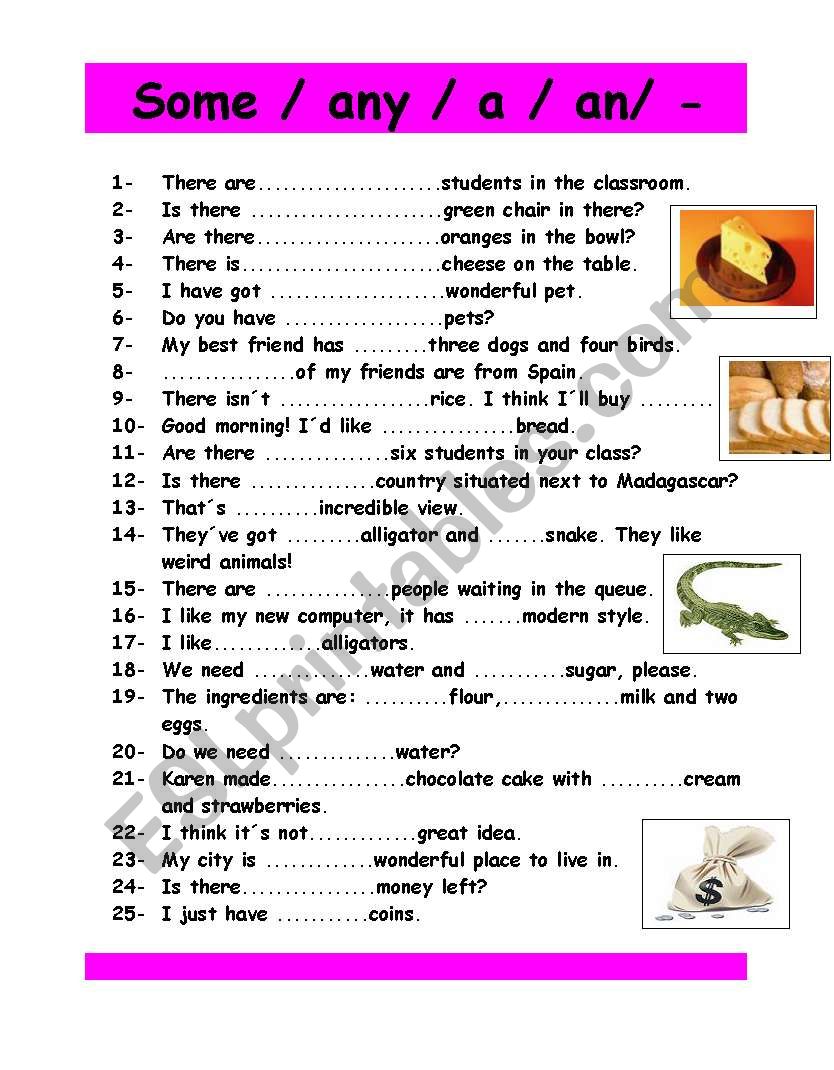
SOME, ANY,A,AN

Resultado de imagen para some any no

some , any , no


Resultado de imagen para some any no


Imagen relacionada
Imagen relacionada


IN ,UNDER, NEXT TO

Resultado de imagen para in on under next to exercises


Resultado de imagen para in on under next to exercises

LOVE, HATE, LIKE

Resultado de imagen para LOVE, HATE LIKE exercises

ADVERBIOS DE FRECUENCIA

  1. They go to the movies. (often)
  2. She listens to classical music. (rarely)
  3. He reads the newspaper. (sometimes)
  4. Sara smiles. (never)
  5. She complains about her husband. (always)
  6. I drink coffee. (sometimes)
  7. Frank is ill. (often)
  8. He feels terrible (usually) 
  9. I go jogging in the morning. (always)
  10. She helps her daughter with her homework. (never)
  11. We watch television in the evening. (always)
  12. I smoke. (never)
  13. I eat meat. (seldom)
  14. I eat vegetables and fruits. (always) 

lunes, 9 de enero de 2017

ADVERBIOS DE FRECUENCIA EJERCITACIÒN


Colocar el adverbio de frecuencia

1. He listens to the radio. (often)
_____________________________
2. They read a book. (sometimes)
_____________________________
3. Pete gets angry. (never)

____________________________

4. Tom is very friendly. (usually)
_____________________________

5. I take sugar in my coffee. (sometimes)
_____________________________

6. Ramon is hungry. (often)
_____________________________

7. My grandmother goes for a walk in the evening. (always)
_____________________________

8. Walter helps his father in the kitchen. (usually)
_____________________________
9. They watch TV in the afternoon. (never)
_____________________________

10. Christine smokes after dinner. (seldom)
--------------------------------------------------------------------------------
1. He plays golf on Sundays. (sometimes)
_____________________________

The weather is bad in November. (always)
_____________________________

3. It rains in California. (never)
_____________________________

4. We have fish for dinner. (seldom)
_____________________________

5. She will see him. (rarely)
_____________________________

6. Peter doesn´t get up before seven. (usually)
_____________________________

7. They do not play tennis on Sundays. (always)
_____________________________
. Mary watches TV. (hardly / ever)
_____________________________

9. I go to school by bus. (always)
_____________________________

10. I get up at seven. (usually)
_____________________________

11. I watch TV in the evening. (often / frequently)

_____________________________

12. I have lunch in a restaurant. (sometimes)

_____________________________

13. I have breakfast. (seldom)
_____________________________

14. I arrive late. (never)
_____________________________

15. I have homework. (every day)

..................................

USO DE ADVERBIOS DE FRECUENCIA


Los adverbios de frecuencia los puedes colocar en distintos lugares de la oración:

1.- Si la oración tiene un verbo (no un verbo auxiliar), coloca el adverbio de frecuencia después del sujeto y antes del verbo.
Diana usually calls after dinner. (Diana normalmente habla después de la cena.)

2.- Si la oración tiene el verbo “to be”, coloca el adverbio de frecuencia después del verbo “be”.
Rachel is often at her office early in the morning. (Raquel esta a menudo en su oficina temprano en la mañana.)

3.- Si la oración tiene más de un verbo (de los cuales uno es auxiliar), coloca el adverbio de frecuencia antes del verbo principal.
I can never do anything when my kid is sick. (Nunca puedo hacer nada cuando mi hijo está enfermo.)

4.- Cuando utilizas los adverbios de frecuencia en preguntas o en la forma negativa, coloca el adverbio de frecuencia antes del verbo principal.
Do you usually brush your teeth after each meal? (¿Normalmente te lavas los dientes después de cada comida?)
Yes, I always brush my teeth after each meal. (Sí, siempre me lavo los dientes después de cada comida.)
She doesn’t often go shopping. (Ella no suele ir de compras.)

5.- Cuando contestas alguna pregunta, normalmente el adverbio de frecuencia lo colocas al principio seguido de una coma, a menos que tu respuesta sea más completa.
Normally, I get up at around at 7 a.m. (Normalmente me levanto alrededor de las 7.)
On weekends and holidays, I always get up late. (Los fines de semana y en vacaciones, siempre me levanto tarde.)

En inglés también se utilizan mucho las frases adverbiales y cláusulas de frecuencia, para expresar la periodicidad con que se realiza una acción:

“How often…?”, “How frequently…?”

annually/yearly – anualmente
quarterly – trimestralmente
monthly – mensualmente
weekly- semanalmente
daily – diariamente
hourly – cada hora
once – una vez
twice – dos veces
once a day – una vez al día
twice a month – dos veces al mes
every other day – cada dos días
every day – todos los días
from time to time – de vez en cuando
once in a while – de vez en cuando
every now and then – de vez en cuando

Las cláusulas de frecuencia pueden ocupar el principio o el final de la oración:
From time to time, I like to try something new. (De vez en cuando me gusta probar algo nuevo.)
She beat them twice. (Les ganó dos veces.)
Every day, I love to receive my Gymglish lesson. (Me encanta recibir todos los días mis lecciones de Gymglish.)